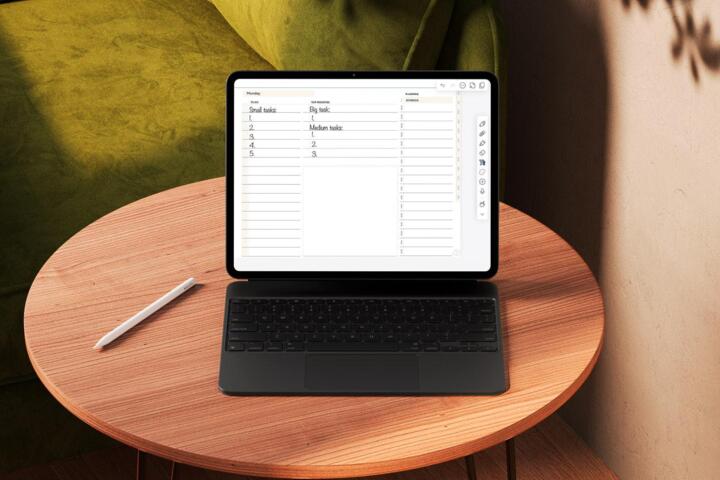
Prioritize With 1-3-5
The 1-3-5 rule limits your daily task list to three tiers: 1 task that matters most, 3 tasks that support it, and 5 tasks that are helpful if time remains. The method works because it forces trade-offs early, before your day fills with meetings, messages, and small requests that quietly expand.
Start by writing everything you could do today, then circle only one item that would make the day feel successful if you finished it. That “1” should be the task with the highest downstream impact, such as submitting a report draft, finishing a key call, or completing a home errand that prevents later problems. Next, list three “3” tasks that reduce friction for the “1,” like gathering inputs, scheduling, or clearing one dependency. Finally, add up to five “5” tasks that are smaller, time-bounded, and easy to stop midstream if the day runs long.
In practice, the rule is less about strict numbers and more about limiting active commitments. If you routinely end the day with 25 unfinished items, the list size itself becomes the problem, not your motivation. I’ve seen planners add more and more categories until the system collapses; the fix is to keep the tiers small even when your brain wants to add “just one more.”
Why Lists Fail
Most daily task lists fail because they mix tasks with different urgency and effort levels without a decision rule. A long list also hides the real constraint: time and attention. When you treat every item as equally important, you end up “working” on whatever is easiest to start, not what moves the day forward.
Another failure mode is dependency blindness. If your “must-do” task requires inputs you do not have yet, you can spend hours on the wrong step, then discover late that you needed a document, an approval, or a link. Supporting technologies matter here: calendar apps, task managers, and email clients shape what you see first. If your task manager shows every item at once, your brain reads the list as a promise to do everything, which increases stress and reduces follow-through.
People also underestimate interruption costs. A message that takes two minutes to answer often triggers follow-up threads, which can turn into 15–30 minutes of context switching. That is why the “5” tier should contain tasks that tolerate interruption, like short admin items or single-step chores.
Finally, lists fail when they become a record of guilt rather than a plan. If you add tasks after the day starts, you are reacting to the day instead of steering it. The rule works best when you set the tiers once, early enough to influence how you spend the next few hours.
Make The Rule Work
Choose The “1” First
Pick one task that you can finish or reach a clear “done enough” milestone today. A good “1” has a visible endpoint, such as “send the proposal email,” “complete the first draft,” or “book the appointment.” If a task is too large, split it into a deliverable you can complete in a single day. Tools that help include a timer (even a simple 25-minute focus block) and a notes app to capture the definition of done.
Realistic outcome targets matter. If your “1” usually takes 4–6 hours, you may need to reduce scope to a 60–120 minute milestone, or you will repeatedly carry it into tomorrow. On my own planning tests, a “1” that fits into two focus blocks tends to survive interruptions better than a “1” that depends on many approvals.
Set “3” Tasks As Support
Write three tasks that remove obstacles for the “1.” Examples include collecting source material, drafting an outline, confirming requirements, or scheduling the next step. Keep these tasks close to the “1” in time and context, so you can switch between them without losing momentum. A practical method is to label each “3” with the dependency it removes, like “get data export” or “confirm meeting agenda.”
Use your calendar to check feasibility. If you have a meeting at 10:00 and another at 14:00, place “3” tasks around those blocks rather than stacking them during the busiest hours. In one week I tracked in a calendar app version 2024.3, I noticed that “3” tasks scheduled between meetings were finished at a higher rate than “3” tasks scheduled after meetings, which often got delayed by follow-up messages.
Limit The “5” Tier
Choose up to five smaller tasks that you can stop when the day ends. Good “5” items include replying to a short email thread, paying a bill, organizing a folder, or doing one household chore that takes 10–20 minutes. Avoid putting tasks with hidden complexity into “5,” such as “research a new laptop,” because that can expand into hours of comparisons and decision fatigue.
To keep the “5” tier honest, set a time cap per item. A simple rule is to assign each “5” task a maximum of one focus block, then move on if it runs long. This prevents the common pattern where the “5” tier becomes a second “1,” and the day ends with nothing truly completed.
Review And Adjust Daily
At the end of the day, record what you completed and what blocked the rest. Do not write a long essay; capture one line per tier, such as “1 done,” “3 partially done,” or “1 blocked by missing input.” That note becomes your feedback loop for tomorrow’s planning. If you consistently miss the “1,” the problem is usually scope or dependencies, not effort.
Adjust the rule without changing its spirit. If you finish the “1” early and still have energy, you can add one extra “5” task, but keep the total list small. If you miss the “1” because of interruptions, reduce the “1” scope further or schedule it earlier, when messages are quieter.
Case Examples For Real Days
Workday With Approvals
Sam works on a monthly compliance report. On Monday, Sam sets the “1” as “send the draft report to the reviewer by 3:00 PM.” The “3” tasks are “pull last month’s metrics,” “update the risk table,” and “confirm the required format.” The “5” tasks include “reply to two vendor emails,” “file receipts,” and “clean up the spreadsheet tabs.”
At 2:30, Sam discovers the reviewer changed the template. The “1” still completes because Sam had already updated the risk table and can quickly reformat. Two “5” tasks remain undone, which is fine because they were designed to be optional. The next day, Sam adds “confirm template version” as a “3” task, since it repeatedly blocks the “1.”
Home Day With Errands
Jordan plans a Saturday with errands and home tasks. The “1” is “submit the pharmacy refill request online,” which prevents a missed medication window. The “3” tasks are “find the prescription number,” “check insurance login,” and “schedule a pickup time.” The “5” tasks include “take recycling out,” “order a replacement filter,” “wipe the kitchen counters,” and “start a small laundry load.”
Jordan runs into a login issue that takes 30 minutes. The “1” still finishes because Jordan uses the “3” tasks to reduce friction: the prescription number is already found, and the insurance login is attempted early. The “5” tier shrinks to two items, and Jordan avoids the common trap of turning “5” into a long research session about filter brands.
Checklist And Trade-Offs
| Tier | What It Should Be | Time Shape | Stop Rule |
|---|---|---|---|
| 1 | One deliverable or “done enough” milestone | Fits 1–2 focus blocks | Stop when the milestone is reached, even if polish remains |
| 3 | Dependencies that unblock the “1” | Scheduled around meetings and known interruptions | Stop when the dependency is removed, not when everything is perfect |
| 5 | Optional, small, interrupt-tolerant tasks | Each capped to a short time window | Stop at the time cap or when the day ends |
Use this step-by-step checklist before you start work:
- Write the full list of possible tasks, then cross out anything that cannot be completed today.
- Choose the “1” by asking which task reduces the most future friction if finished today.
- Choose three “3” tasks that remove dependencies for the “1,” not tasks that merely feel productive.
- Choose up to five “5” tasks that fit inside short time windows and tolerate interruption.
- Schedule the “1” first on your calendar, then place “3” tasks around it.
- Plan one buffer block for messages or delays, because interruptions rarely respect your list.
Common Mistakes To Avoid
A frequent mistake is treating the “1” as a vague goal like “work on taxes.” That phrasing lacks a finish line, so the task expands until it becomes a source of stress. Replace it with a deliverable such as “submit the tax documents to the accountant” or “complete the worksheet for deductions.”
Another mistake is loading the “5” tier with tasks that require deep focus. If a “5” task takes longer than one focus block, it will steal time from the “1” and “3” tiers. People also overuse the rule as a way to justify doing everything; the numbers are a constraint, not a permission slip.
Some planners forget to account for dependencies. If you list “call the dentist” as a “1” but you do not have the insurance details, you will lose momentum and blame yourself. A better approach is to move “find insurance info” into the “3” tier so the “1” can start immediately.
Finally, many people revise the tiers mid-day without recording why. If you change the “1” repeatedly, you lose the feedback loop that teaches you what your day actually allows. Keep a short note about what blocked the plan, then adjust tomorrow’s scope rather than constantly rewriting today.
FAQ
How Do I Pick The “1” Task?
Choose the task with the clearest finish line today and the biggest downstream effect, such as sending a draft, booking an appointment, or completing a required submission.
What If I Finish The “1” Early?
Stop and reassess before adding new tasks. If you still have time, move one “5” task forward or add one extra small item, but keep the total list limited.
Can I Use The Rule For Multiple Areas?
Yes, but keep the tiers small per day. If you need separate work and home plans, run the rule twice with fewer total items, or combine them into one list with a single “1.”
What If My Day Is Full Of Meetings?
Schedule the “1” around the meeting blocks and choose “3” tasks that can be done in short gaps. Put message-heavy tasks into the “5” tier so they do not compete with the deliverable.
How Long Should I Track Results?
Track for 7–14 days to learn your realistic “1” scope and common blockers. After that, keep the notes lightweight and adjust only when the pattern changes.
Author's Insight
The 1-3-5 rule works because it limits active commitments and forces early decisions about dependencies. Task prioritization research and practical productivity methods consistently show that smaller, well-defined goals reduce the gap between intention and action. The biggest determinant of success is not willpower; it is whether the “1” has a finish line and whether the “3” tasks remove the inputs needed to reach it.
When people fail with the rule, the pattern usually involves scope creep, missing dependencies, or underestimating interruption costs. A short daily review note turns those failures into measurable adjustments for the next day. If you want a tool, a simple checklist in a notes app or a task manager with due dates can work; the method matters more than the software.
Key Takeaways
- Write one “1” deliverable with a clear finish line, then build “3” tasks that remove dependencies for it.
- Keep “5” tasks small and interrupt-tolerant, with time caps so they do not expand into the main work.
- Schedule the “1” first, add a buffer for messages, and avoid rewriting the tiers without noting the blocker.
- Use a 7–14 day review to calibrate your “1” scope to what your day actually supports.